

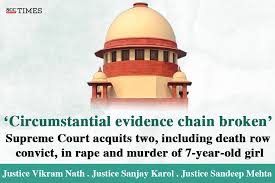
Supreme Court Acquittal in Circumstantial Evidence Based Capital Case – A Landmark Reaffirmation of Criminal Jurisprudence
Supreme Court Acquittal in Circumstantial Evidence Based Capital Case – A Landmark Reaffirmation of Criminal Jurisprudence
The recent judgment of the Hon’ble Supreme Court of India acquitting two accused, including a death row convict, in the alleged rape and murder of a seven year old girl is a powerful reaffirmation of the foundational principles of criminal law and constitutional justice.
The Court set aside the conviction after holding that the prosecution failed to establish a complete and unbroken chain of circumstantial evidence. The alleged motive was not convincingly proved. The last seen theory stood contradicted. The scientific and forensic evidence was marred by inconsistencies and procedural lapses. In such circumstances, the Hon’ble Court rightly held that it would be wholly unsafe to sustain the conviction, much less confirm the extreme penalty of death.
Legal Views by Dr Anthony Raju
Advocate Supreme Court of India
Chairman All India Council of Human Rights Liberties and Social Justice
I respectfully appreciate the Hon’ble Supreme Court for upholding the settled doctrine that suspicion, however strong, cannot take the place of proof. In criminal jurisprudence, particularly in cases resting solely on circumstantial evidence, every link must be firmly established and must exclude every hypothesis except that of guilt. If even one link breaks, the entire chain collapses.
This judgment reinforces three vital principles:
First, the presumption of innocence is not a mere technicality but a human right embedded in Article 21 of the Constitution of India.
Second, in cases where two views are possible, the view favourable to the accused must prevail. This is not generosity toward crime; it is fidelity to the rule of law.
Third, the death penalty demands the highest standard of judicial scrutiny. The irreversible nature of capital punishment requires courts to exercise extreme caution. A conviction based on doubtful or incomplete evidence cannot be allowed to stand.
The judgment also indirectly highlights the urgent need for professional, scientific and accountable investigation in serious offences. A defective investigation not only weakens the prosecution but also risks miscarriage of justice either by punishing the innocent or allowing the guilty to escape.
While the crime alleged is undoubtedly heinous and evokes deep emotional anguish, criminal courts are guided not by emotion but by evidence, law and constitutional safeguards. Justice must be based on proof beyond reasonable doubt, not public sentiment.
I commend the Hon’ble Supreme Court for reaffirming that constitutional morality and due process remain supreme even in the most sensitive and serious criminal cases. This judgment strengthens public confidence in the judiciary as the final guardian of liberty and justice.
Dr Anthony Raju
Advocate Supreme Court of India
Chairman
All India Council of Human Rights Liberties and Social Justice
If you would like, I can now convert this into a press release format, YouTube script, PDF brochure, or social media carousel with strong legal hashtags including
humanrightscommission
humanrightscouncilofindia
humanrightscommissionofindia