
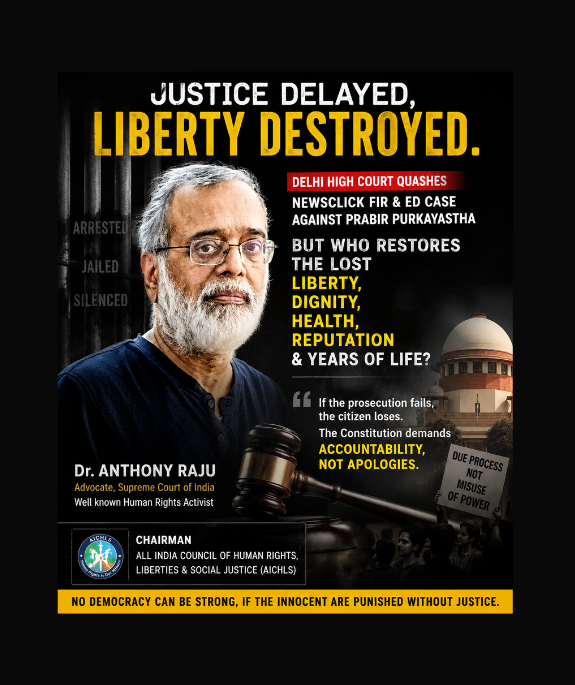
225 DAYS STOLEN. CASE QUASHED. WHO PAYS FOR THE LOST FREEDOM?
225 DAYS STOLEN. CASE QUASHED. WHO PAYS FOR THE LOST FREEDOM?
Dr. Anthony Raju Calls for Compensation Law for Wrongful Prosecution
The recent judgment of the Delhi High Court quashing the FIR and Enforcement Directorate proceedings against NewsClick and its founder has once again exposed a critical gap in India's criminal justice system: What remedy exists for an innocent citizen who spends months or years under investigation, prosecution, incarceration, public scrutiny, and social stigma, only to be declared innocent in the end?
The High Court reportedly found no cognizable offence and described the proceedings as a "gross abuse of law." While the judgment restores legal innocence, it cannot restore the time, liberty, opportunities, reputation, and emotional well-being lost during the process.
Dr. Anthony Raju's Perspective
Dr. Anthony Raju, Advocate, Supreme Court of India and Chairman, National Legal Aid Council (NLAC), observed:
"Acquittal alone is not justice when the process itself becomes punishment. When an individual loses years of freedom, livelihood, reputation, and peace of mind due to a prosecution that ultimately collapses in court, the legal system must recognize and compensate that loss."
According to Dr. Raju, India urgently requires a comprehensive statutory framework providing compensation and rehabilitation to victims of wrongful prosecution, malicious investigation, and unjust incarceration.
He further stated:
"Article 21 of the Constitution guarantees not merely life, but a life with dignity. If the State possesses the authority to investigate and prosecute, it must equally bear responsibility when that power is exercised without sufficient legal foundation, resulting in irreversible harm to innocent citizens."
The Larger Constitutional Question
The NewsClick judgment is not merely about one organisation or one accused person. It raises a broader constitutional question concerning accountability within the criminal justice system.
Courts may quash proceedings and restore legal innocence. However, judicial orders alone cannot compensate for:
-
Years lost in litigation.
-
Damage to professional careers and businesses.
-
Emotional trauma and mental distress.
-
Financial losses incurred during prolonged proceedings.
-
Family hardships and social isolation.
-
Permanent injury to personal and professional reputation.
Reforms Advocated by Dr. Anthony Raju
Dr. Anthony Raju has urged policymakers and legal institutions to consider:
✅ Statutory compensation for wrongful prosecution and illegal detention.
✅ Personal accountability where investigations are found to be malicious, reckless, or without legal basis.
✅ Fast-track judicial mechanisms for victims of abuse of process.
✅ Stronger safeguards to protect constitutional rights guaranteed under Article 21.
✅ Recognition that legal exoneration after years of suffering often amounts to only partial justice.
Conclusion
The Delhi High Court's observations serve as a reminder that justice is not measured solely by the conviction of the guilty. A truly fair justice system must also protect innocent citizens from unnecessary persecution and provide meaningful remedies when state power is misused.
The rule of law is strengthened not only when offenders are punished, but also when the dignity, liberty, and constitutional rights of innocent individuals are effectively protected.
Dr. Anthony Raju
Advocate, Supreme Court of India
Chairman, National Legal Aid Council (NLAC)
📞 WhatsApp: +91 8588872001
📧 Email: office@humanrightscouncil.in
#humanrightscommission #humanrightscouncilofindia #humanrightscommissionofindia