

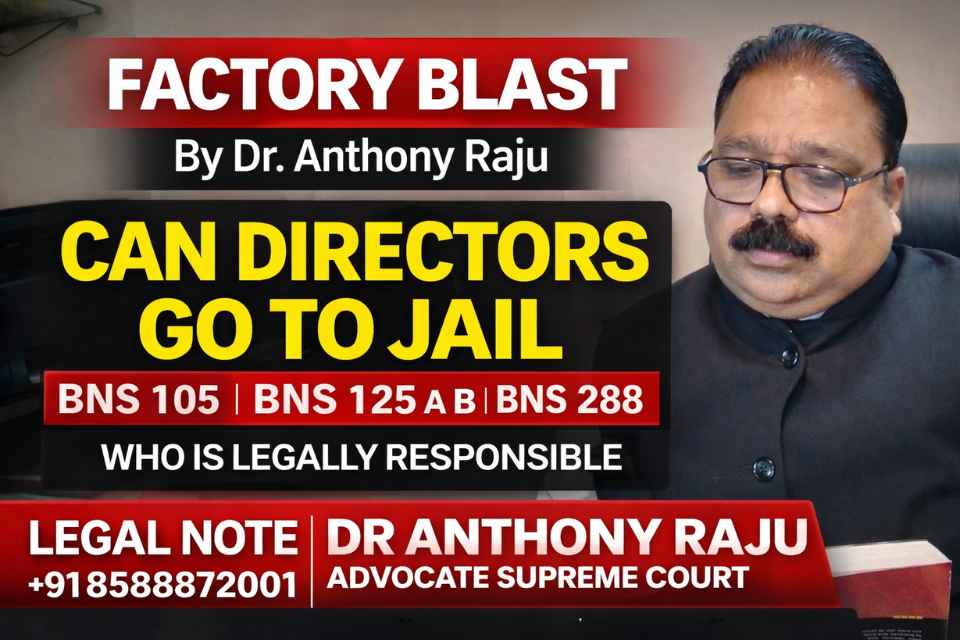
Culpable Homicide Not Amounting to Murder
LEGAL NOTE
By Dr Anthony Raju
Advocate Supreme Court of India
BNS SECTION 105
Culpable Homicide Not Amounting to Murder
This section applies when a person causes the death of another person, but the act does not amount to murder. The law recognises that death may occur because of a dangerous act done with knowledge that it may likely cause death, even if there was no direct intention to kill.
In industrial accidents or factory blasts, this section may be invoked if the prosecution claims that the accused persons had knowledge that unsafe conditions, defective machinery, or illegal handling of hazardous material could lead to loss of life.
Punishment under this section can extend to life imprisonment or imprisonment up to ten years along with fine, depending upon the circumstances and degree of responsibility.
However, in many industrial accident cases, defence may argue that there was no intention and no prior knowledge of the risk, which may reduce the liability to lesser negligence offences.
BNS SECTION 125 (A) AND 125 (B)
Rash or Negligent Act Endangering Human Life
This provision deals with acts that are performed rashly or negligently, which endanger human life or the personal safety of others.
The law recognises that sometimes individuals or organisations may perform acts without proper care or precaution, which creates a dangerous situation.
For example
Unsafe factory operations
Improper safety measures
Ignoring industrial safety protocols
Operating machinery without safeguards
If such negligence causes injury or grievous injury, punishment becomes more serious.
This section is often applied in industrial accidents, road accidents, construction negligence, and workplace safety violations.
The punishment may include imprisonment, fine, or both, depending on the gravity of the negligence.
BNS SECTION 288
Negligent Conduct with Explosive Substances
This section specifically addresses negligence in handling explosive substances or dangerous materials.
It applies when a person who is responsible for storing, handling, transporting, or using explosive substances acts negligently in a manner that endangers human life or property.
Examples include
Improper storage of explosive chemicals
Failure to follow safety regulations in factories
Illegal or careless handling of fireworks or blasting materials
Ignoring government safety guidelines for hazardous materials
In cases of factory explosions, mining accidents, or firecracker factory blasts, this section is frequently invoked.
The law aims to ensure that persons dealing with hazardous substances exercise the highest degree of care and responsibility.
Violation may result in imprisonment, fine, or both, depending on the seriousness of the negligence.
Legal Perspective in Industrial Disaster Cases
In major industrial accidents such as factory blasts, investigators often invoke a combination of these provisions.
BNS 105 may be invoked if deaths occur and authorities believe the accused had knowledge of dangerous conditions.
BNS 125 addresses the general negligence that endangered human life.
BNS 288 specifically focuses on negligence involving explosive or hazardous substances.
Determining liability requires careful examination of
Safety compliance
Role of directors and management
Responsibility of technical staff and safety officers
Licensing and regulatory
Dr Anthony Raju is a well-known Advocate of the Supreme Court of India, widely respected for handling complex legal matters including industrial disputes, factory blast cases, compliance and safety violations, environmental litigation, and matters before the National Green Tribunal. He is regarded as one of the country’s most reputed criminal and regulatory law advocates.
#SupremeCourtLawyer
#CriminalLawIndia
#LegalAwarenessIndia
#FactoryBlastCase
#IndustrialSafetyLaw
#BNS105
#humanrightscommission
#humanrightscouncilofindia
#humanrightscommissionofindia