
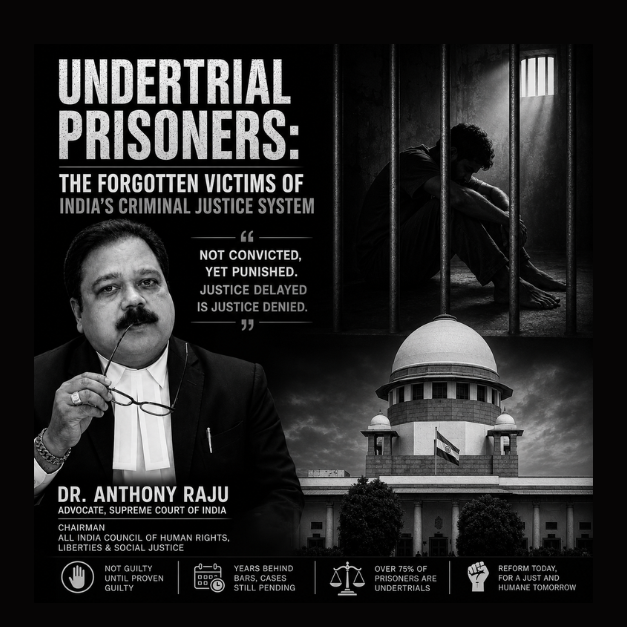
Undertrial Prisoners: The Forgotten Victims of India's Criminal Justice System
Undertrial Prisoners: The Forgotten Victims of India's Criminal Justice System
When Justice is Delayed, Freedom Becomes the First Casualty
By Dr. Anthony Raju
Advocate, Supreme Court of India
Introduction
India proudly calls itself the world's largest democracy, founded on the principles of Justice, Liberty, Equality, and Fraternity. The Constitution of India guarantees every citizen the Right to Life and Personal Liberty under Article 21, while our criminal justice system is built upon the cardinal principle that every accused person is presumed innocent until proven guilty in a court of law.
Yet, behind the walls of India's overcrowded prisons lies one of the most neglected human rights concerns of our time—the plight of undertrial prisoners.
Thousands of individuals remain incarcerated for months or even years without being convicted of any offence. Many are eventually acquitted, but by then they have already lost their freedom, employment, education, family life, reputation, physical and mental health, and invaluable years that can never be restored.
When a person remains imprisoned not because a court has declared them guilty, but because investigations are delayed, trials are prolonged, or the justice delivery system moves slowly, the process itself becomes the punishment.
The issue of undertrial prisoners is not merely a prison administration problem; it is a constitutional, legal, humanitarian, and governance challenge that deserves immediate national attention.
Who is an Undertrial Prisoner?
An undertrial prisoner is a person who has been arrested and is awaiting investigation, inquiry, or trial but has not been convicted by any court of law.
The cornerstone of criminal jurisprudence is simple:
"Every accused person is innocent until proven guilty beyond reasonable doubt."
However, prolonged pre-trial detention often erodes this fundamental constitutional protection.
In a democracy governed by the Rule of Law, imprisonment before conviction should remain an exceptional measure, not a routine consequence of procedural delays.
The Reality Inside Indian Prisons
A significant proportion of India's prison population consists of undertrial prisoners.
The reasons are numerous:
- Delay in police investigations.
- Delay in filing charge sheets.
- Repeated adjournments.
- Huge backlog of criminal cases.
- Shortage of judges.
- Delay in forensic reports.
- Slow prosecution.
- Non-production of accused before courts.
- Financial inability to furnish bail.
- Lack of quality legal representation.
- Administrative inefficiencies.
For thousands of poor and marginalized citizens, poverty itself becomes an invisible sentence, as they remain in custody simply because they cannot afford legal assistance or comply with bail conditions.
Justice must never become a privilege available only to those who can afford it.
Justice Delayed Becomes Punishment Before Conviction
The timeless legal maxim—
"Justice Delayed is Justice Denied."
—is perhaps nowhere more relevant than in the case of undertrial prisoners.
Years spent behind bars before trial often result in:
- Loss of liberty.
- Loss of employment.
- Interrupted education.
- Financial ruin.
- Family disintegration.
- Mental trauma.
- Social stigma.
- Loss of dignity.
Even if a person is ultimately acquitted, no judicial order can restore the years already lost.
Freedom once taken away without timely adjudication leaves permanent scars.
Bail Should Be the Rule
Indian constitutional jurisprudence has consistently emphasized that:
"Bail is the Rule, Jail is the Exception."
Personal liberty is one of the highest constitutional values.
Yet thousands of undertrial prisoners continue to remain incarcerated for periods longer than the sentence they may ultimately receive upon conviction.
Such situations weaken public confidence in the administration of justice and call for a more effective implementation of constitutional principles.
Human Rights Do Not End at the Prison Gate
Every undertrial prisoner continues to enjoy the protection of the Constitution.
Prolonged detention without conviction affects:
- Right to Life and Personal Liberty.
- Right to Speedy Trial.
- Right to Fair Trial.
- Right to Legal Aid.
- Right to Equality before Law.
- Right to Human Dignity.
- Protection against arbitrary detention.
An arrest does not extinguish constitutional rights.
The dignity of every human being remains protected until guilt is established through a fair judicial process.
The Hidden Economic Cost
Delayed criminal trials affect not only prisoners but also the nation.
The burden falls upon:
- Taxpayers.
- Prison administration.
- Police machinery.
- Judicial infrastructure.
- Government resources.
- Families of prisoners.
Overcrowded prisons increase public expenditure while reflecting deeper systemic inefficiencies.
Justice delayed is not merely a legal concern—it is an economic challenge for the nation.
Families Become Silent Victims
When an undertrial prisoner loses liberty, the punishment often extends to innocent family members.
Children discontinue education.
Parents lose support.
Spouses face financial hardship and social isolation.
Entire families suffer emotional trauma despite no judicial finding of guilt.
The consequences continue long after the trial ends.
Mental Health and Human Dignity
Extended incarceration before conviction frequently results in:
- Depression.
- Anxiety.
- Emotional trauma.
- Social isolation.
- Loss of self-worth.
- Psychological distress.
Justice must preserve both liberty and dignity.
Punishment before conviction has lasting consequences that no acquittal can completely erase.
Constitutional Responsibility
The Constitution promises:
- Liberty.
- Equality.
- Fair Trial.
- Due Process.
- Human Dignity.
The Judiciary, Investigating Agencies, Prosecution, Prison Authorities, Governments, and Legal Institutions all share a constitutional obligation to ensure these guarantees become a living reality rather than constitutional ideals.
The Need for Judicial Reforms
Meaningful reforms require:
- Speedy investigation.
- Timely filing of charge sheets.
- Appointment of additional judges.
- Strengthening district courts.
- Modern digital case management.
- Scientific forensic infrastructure.
- Reduction of unnecessary adjournments.
- Liberal grant of bail wherever legally appropriate.
- Expansion of free legal aid.
- Periodic judicial review of prolonged detention.
- Prison reforms and independent oversight.
- Technology-enabled court proceedings.
Judicial reform is not merely desirable—it is indispensable.
Restoring Faith in Justice
A justice system earns respect not simply through convictions but through fairness, transparency, and timely adjudication.
Every citizen should have confidence that:
- Liberty will be protected.
- Innocence will be respected.
- Trials will be conducted without unreasonable delay.
- Constitutional rights will remain meaningful.
- Justice will be accessible irrespective of economic status.
A Collective National Responsibility
Addressing the undertrial crisis requires coordinated efforts from:
- Judiciary.
- Legislature.
- Executive.
- Police.
- Prosecution.
- Prison Administration.
- Bar Associations.
- Legal Services Authorities.
- Human Rights Institutions.
- Civil Society.
Justice is not the responsibility of one institution alone—it is the shared responsibility of every pillar of democracy.
Conclusion
The true strength of a democracy is measured not by the number of convictions it secures, but by its unwavering commitment to protecting the liberty of every individual until guilt is established through a fair and impartial trial.
The plight of undertrial prisoners is not merely a legal issue.
It is a constitutional concern.
It is a human rights challenge.
It is a question of governance.
It is a moral responsibility.
When liberty is lost because justice is delayed, democracy itself is tested.
India's commitment to the Rule of Law will ultimately be judged by its ability to ensure that no innocent person spends years behind bars awaiting justice.
A prison should never become a waiting room for constitutional rights.
About the Author
Dr. Anthony Raju is an Advocate practicing before the Supreme Court of India and various High Courts. He is the Founder & Global Chairman of the All India Council of Human Rights, Liberties & Social Justice (AICHLS) and the Managing Partner of Legal & Legal Associates. He has extensive experience in criminal law, constitutional litigation, bail jurisprudence, POCSO matters, CBI, ED, NIA, PMLA, and human rights advocacy, and actively works for judicial reforms, legal aid, and access to justice.
Undertrial Prisoners in India | Constitutional Rights, Judicial Delays & Criminal Justice Reforms
Learn about the undertrial prisoner crisis in India, Article 21, the right to a speedy trial, bail jurisprudence, prison reforms, judicial delays, and why criminal justice reforms are essential to protect constitutional liberties.
Undertrial Prisoners India, Undertrial Prisoners Rights, Criminal Justice System India, Indian Judiciary, Judicial Reforms, Prison Reforms, Article 21, Right to Speedy Trial, Bail in India, Human Rights India, Constitutional Rights, Rule of Law, Access to Justice, Legal Aid, Prison Overcrowding, Due Process, Criminal Law India.
undertrial prisoners, undertrial prisoners in India, Article 21 Constitution of India, criminal justice system India, prison reforms India, judicial reforms India, bail in India, right to speedy trial, legal aid India, constitutional rights India, rule of law, human rights India, prison overcrowding, due process, criminal law, Supreme Court advocate, justice delayed justice denied.
#UndertrialPrisoners #JusticeDelayedJusticeDenied #IndianJudiciary #Article21 #HumanRights #CriminalJustice #PrisonReforms #JudicialReforms #RuleOfLaw #RightToSpeedyTrial #AccessToJustice #LegalAid #ConstitutionOfIndia #HumanRightsIndia #JusticeForAll #LegalAwareness #SupremeCourt #DrAnthonyRaju #AdvocateSupremeCourt #IndianLaw