
The Crisis of Undertrial Prisoners in India: When Pre-Trial Detention Becomes Punishment
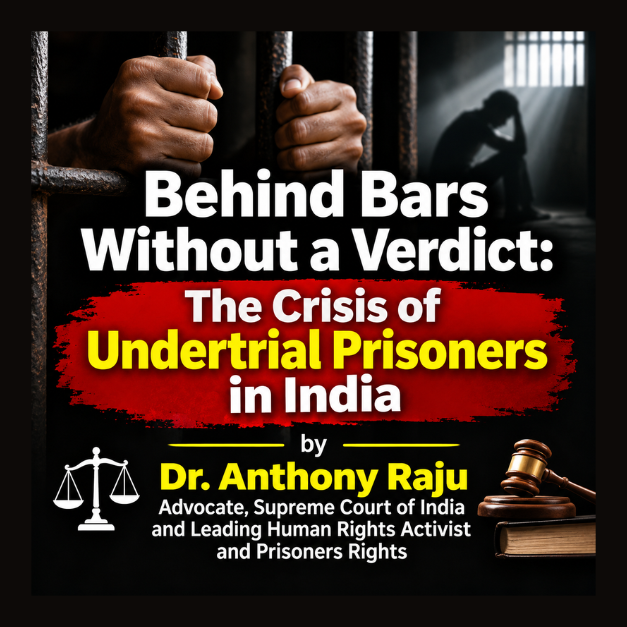
BEHIND BARS WITHOUT A VERDICT
The Crisis of Undertrial Prisoners in India: When Pre-Trial Detention Becomes Punishment
By Dr. Anthony Raju
Advocate, Supreme Court of India | Leading Human Rights Activist & Prisoners' Rights Advocate
INTRODUCTION: WHEN LIBERTY BECOMES A DISTANT DREAM
In a constitutional democracy governed by the rule of law, every individual is presumed innocent until proven guilty by a competent court. Yet, in India, this fundamental principle faces a disturbing reality: millions of questions surround a prison system in which a substantial majority of inmates are still awaiting trial.
According to the National Crime Records Bureau (NCRB), Prison Statistics India 2024, India's prisons housed 5,11,542 inmates at the end of 2024. Of these, approximately 3,71,440 were undertrial prisoners, accounting for nearly 72.6% of the total prison population.
These are individuals who have not been convicted of the offences for which they are being detained. Many have spent months or years behind bars, waiting for investigations, court proceedings, bail decisions or the conclusion of trials.
This raises a fundamental constitutional question:
Can a country that guarantees the right to life and personal liberty under Article 21 allow people to spend years in prison without a final judicial determination of their guilt?
The problem is not merely overcrowding in prisons. It is a crisis of constitutional justice, human dignity and institutional accountability.
1. WHO ARE THE UNDERTRIAL PRISONERS?
Behind every prison statistic is a human story.
An undertrial prisoner may be a daily-wage worker, a farmer, a migrant labourer, a young student, a small businessman or the sole earning member of a family.
The burden of pre-trial detention falls particularly heavily on economically disadvantaged and socially vulnerable communities.
Many prisoners lack adequate education, financial resources, legal awareness and access to effective legal representation. Some cannot even arrange the sureties required to comply with bail conditions granted by a court.
The consequences extend far beyond prison walls:
- Children lose the emotional and financial support of their parents.
- Families fall into debt and poverty.
- Employment and livelihood opportunities disappear.
- Social stigma damages the reputation of individuals and their families.
- Young people lose critical years of education, employment and personal development.
The tragedy is that even if an accused person is ultimately acquitted, nobody can return the years spent behind bars.
2. WHY ARE THOUSANDS OF UNDERTRIALS STILL IN JAIL?
Several structural weaknesses contribute to this alarming situation.
A. Poverty and the Bail Bond Problem
One of the most troubling aspects of India's criminal justice system is the unequal impact of bail conditions.
Two individuals facing similar allegations may receive bail, but their circumstances can be entirely different. One may arrange the required financial bond and sureties immediately, while the other remains imprisoned simply because of poverty.
This creates an unacceptable situation in which economic capacity influences the enjoyment of personal liberty.
Liberty must never become a privilege available only to those who can afford it.
B. Judicial Backlog and Delayed Trials
The enormous pendency of cases across Indian courts places tremendous pressure on the judicial system.
Delayed investigations, repeated adjournments, unavailable witnesses, forensic delays and inadequate judicial infrastructure contribute to prolonged incarceration.
An accused person should not be made to suffer indefinitely because the institutions responsible for delivering justice cannot complete proceedings within a reasonable time.
C. Unnecessary and Arbitrary Arrests
Arrest should never become a routine response to every criminal allegation.
The Supreme Court has repeatedly emphasised that arrest must comply with statutory requirements and constitutional safeguards.
In Arnesh Kumar v. State of Bihar (2014), the Supreme Court cautioned against unnecessary arrests and mechanical remand practices.
The police must understand that the power to arrest is not an unrestricted authority to deprive citizens of liberty.
D. Inadequate Legal Representation
Legal aid is a constitutional necessity, not an administrative formality.
Many undertrial prisoners do not understand their legal rights, bail provisions, available remedies or the procedural stages of their cases.
A lawyer appointed on paper does not necessarily mean effective legal representation.
Every prisoner deserves meaningful legal assistance from the earliest stage of criminal proceedings.
3. THE CONSTITUTIONAL GUARANTEE: LIBERTY IS A FUNDAMENTAL RIGHT
The Indian Constitution provides powerful safeguards against arbitrary deprivation of liberty.
Article 14 – Equality Before Law
Every individual is entitled to equal protection of the laws. Financial status must not determine access to justice.
Article 21 – Right to Life and Personal Liberty
No person shall be deprived of life or personal liberty except according to procedure established by law. The Supreme Court has interpreted this provision to include fairness, reasonableness and the right to a speedy trial.
Article 22 – Protection Against Arbitrary Arrest and Detention
The Constitution guarantees important safeguards to arrested persons, including the right to be informed of the grounds of arrest and the right to consult and be defended by a legal practitioner.
These are not optional protections. They are constitutional obligations.
4. LANDMARK SUPREME COURT JUDGMENTS THAT PROTECT UNDERTRIAL PRISONERS
India's Supreme Court has consistently recognised the importance of personal liberty and speedy justice.
1. Hussainara Khatoon v. State of Bihar (1979)
A landmark judgment recognising the right to a speedy trial as an integral part of Article 21. The case exposed the shocking conditions of undertrial prisoners who had remained incarcerated for prolonged periods.
2. Moti Ram v. State of Madhya Pradesh (1978)
The Supreme Court emphasised that bail conditions should not be unreasonable or oppressive. Poverty should not prevent an accused person from securing release.
3. D.K. Basu v. State of West Bengal (1997)
The Court laid down important safeguards concerning arrest and detention to prevent custodial abuse and protect human dignity.
4. Arnesh Kumar v. State of Bihar (2014)
The Supreme Court emphasised that arrest should not be automatic and that police officers must comply with the statutory requirements governing arrest.
5. Satender Kumar Antil v. CBI (2022)
The Supreme Court issued important directions concerning arrest, bail and unnecessary incarceration, reinforcing the need to protect personal liberty.
These judgments establish a consistent constitutional message:
The object of criminal procedure is to secure justice, not to punish an accused person before conviction.
5. SECTION 479 BNSS: A SIGNIFICANT LEGAL SAFEGUARD
The Bharatiya Nagarik Suraksha Sanhita, 2023 (BNSS), introduced Section 479, replacing the earlier Section 436A of the Code of Criminal Procedure, 1973.
This provision seeks to address prolonged undertrial detention.
Its principal safeguards include:
- An undertrial prisoner who has undergone detention for one-half of the maximum period of imprisonment prescribed for the alleged offence may be eligible for release on bail, subject to statutory conditions and exceptions.
- A first-time offender may be eligible for release on bond after undergoing detention for one-third of the maximum period of imprisonment.
- The jail superintendent has a statutory responsibility to make an application to the court when the applicable eligibility threshold is reached.
- The provision contains important exceptions, including restrictions relating to offences punishable with death or life imprisonment and cases involving multiple offences or multiple pending proceedings.
The provision must be applied with due consideration to its statutory requirements. It does not mean that every undertrial is automatically entitled to release.
However, its effective implementation can prevent thousands of eligible prisoners from remaining unnecessarily incarcerated.
6. SUPPORT TO POOR PRISONERS SCHEME: A STEP TOWARDS ECONOMIC JUSTICE
The Government of India introduced the Support to Poor Prisoners Scheme in 2023 to assist eligible indigent prisoners who are unable to secure release because of financial constraints, including inability to pay bail amounts or fines.
This is a welcome initiative.
However, the success of such a scheme depends on effective implementation, awareness among prisoners, coordination with prison authorities and legal services institutions, and transparent monitoring of financial assistance.
A scheme cannot fulfil its purpose if eligible prisoners remain unaware of their rights or cannot access its benefits.
7. THE URGENT NEED FOR NATIONAL PRISON REFORMS
India needs a comprehensive and time-bound approach to the undertrial crisis.
I strongly recommend the following reforms:
1. Mandatory Undertrial Reviews
Under Trial Review Committees (UTRCs) must conduct regular and meaningful reviews of eligible prisoners, particularly those facing prolonged incarceration.
2. Effective Implementation of Section 479 BNSS
Every prison should maintain an updated record of undertrial prisoners approaching the statutory detention thresholds. Eligible cases should be promptly placed before the competent court.
3. Personal Bonds and Relaxed Surety Conditions
Courts should consider personal bonds and proportionate bail conditions wherever legally permissible, particularly for indigent accused persons.
4. Strengthening Legal Aid Defence Counsel Systems
Every district should have adequately staffed Legal Aid Defence Counsel offices capable of providing effective representation from the earliest stages of criminal proceedings.
5. Accountability for Unnecessary Delays
Investigating agencies, prosecutors and other responsible authorities must address avoidable delays in investigation, filing of reports and trial proceedings.
6. Regular Prison Inspections
Independent inspections should examine overcrowding, legal aid access, healthcare, sanitation, mental well-being and the treatment of undertrial prisoners.
7. Rehabilitation and Family Support
Prison reforms must protect the dignity of prisoners and ensure access to education, healthcare, family contact and rehabilitation opportunities.
8. WHO WILL BE ACCOUNTABLE FOR THE LOST YEARS?
This is perhaps the most important question.
When an accused person spends five or ten years in prison and is subsequently acquitted, what happens to the lost years?
Who takes responsibility for the destruction of livelihood, the breakdown of families, the loss of childhood for dependent children and the social stigma suffered by the accused?
The presumption of innocence must mean more than a legal phrase written in textbooks and court judgments.
It must be reflected in police practices, judicial procedures, bail decisions, prison administration and access to legal representation.
A system that fails to deliver a timely trial must not allow the accused to bear the entire cost of that failure.
There must be meaningful institutional accountability, and appropriate remedies should be considered where unlawful or unjustified detention is established.
9. A CALL TO ACTION: JUSTICE MUST NOT BE A PRIVILEGE OF THE WEALTHY
The undertrial crisis is not simply a prison administration problem. It is a national human rights concern that demands urgent attention from Parliament, the judiciary, governments, police authorities, prosecution agencies and legal services institutions.
The Government must move beyond policy announcements and ensure that constitutional safeguards reach the last person standing behind prison bars.
The judiciary must continue to protect personal liberty. Police authorities must exercise arrest powers responsibly. Legal services institutions must ensure effective representation. Prison authorities must identify eligible prisoners and facilitate timely judicial review.
Most importantly, society must recognise that an undertrial prisoner is not a convicted criminal.
A person awaiting trial is entitled to dignity, constitutional protection and the presumption of innocence.
CONCLUSION: A PRISON CELL MUST NOT BECOME A COURTROOM
India is a constitutional democracy founded on justice, liberty, equality and fraternity.
The true strength of our justice system should not be measured merely by the number of arrests, prosecutions or convictions. It must also be measured by how effectively it protects the liberty of those who have not been found guilty.
No person should lose years of their life merely because the wheels of justice move too slowly. No poor person should remain in prison simply because they cannot afford bail. No family should be condemned to suffering because the system has failed to deliver a timely trial.
We must remember one fundamental principle:
BAIL SHOULD NOT DEPEND ON WEALTH. JUSTICE SHOULD NOT DEPEND ON STATUS. AND LIBERTY SHOULD NOT BE THE VICTIM OF JUDICIAL DELAY.
India needs urgent prison reforms, stronger legal aid, responsible policing and a justice delivery system that respects the dignity of every human being.
The time has come to transform the principle of presumption of innocence from a constitutional promise into a lived reality.
Because behind every prison number is a human being, behind every undertrial is a family, and behind every delayed trial may be a life permanently damaged.
Dr. Anthony Raju
Advocate, Supreme Court of India
Leading Human Rights Activist & Prisoners' Rights Advocate
Chairman, All India Council of Human Rights, Liberties & Social Justice (AICHLS)
Chairman, Indian National Human Rights Protection Council
Founder – International Human Rights Awards
OUR MESSAGE: JUSTICE FOR ALL, LIBERTY FOR ALL, DIGNITY FOR ALL.
Legal awareness and human rights advocacy article. Individual cases require examination of their facts, applicable laws and judicial orders.
DISCLAIMER
This article is intended solely for public awareness, legal education and discussion of human rights, constitutional safeguards and prison reforms in India. The views expressed are those of the author, Dr. Anthony Raju, in his capacity as an Advocate and human rights activist.
The statistics and information referred to are based on publicly available reports, legal provisions and judicial pronouncements. While every effort has been made to ensure accuracy, readers are advised to verify the latest official data, applicable laws and judicial decisions from authoritative sources.
Nothing in this article should be construed as legal advice, an allegation against any particular individual or institution, or a suggestion that every undertrial prisoner is innocent of the alleged offence. Guilt or innocence must be determined by a competent court in accordance with law and due process.
The article does not intend to undermine the criminal justice system, but seeks to encourage constructive reforms, institutional accountability, protection of personal liberty and respect for the constitutional rights and dignity of every individual.
The fundamental principle remains: Every accused person is presumed innocent until proven guilty in accordance with law.
#UndertrialPrisoners #PrisonReformsIndia #JusticeForAll #HumanRights #RightToLiberty #Article21 #SpeedyTrial #BailNotJail #PrisonersRights #IndianJudiciary #LegalReforms #JusticeDelayedIsJusticeDenied #DrAnthonyRaju #AICHLS #HumanRightsActivist
- Undertrial Prisoners Crisis in India
- Prison Reforms and Prisoners Rights
- Article 21 Right to Liberty
- Bail Not Jail and Speedy Trial
- Dr Anthony Raju Human Rights Advocate